Wednesday, 1 December 2010

Week9 - Blue sky


Future Chinese online market

E-retailing market has almost reached maturity in developed countries. At the current growth rate, China has the largest internet user base in the not too distant future now (Pingdom, 2010) (figure 1). And online shopping population are continuously growing in China nowadays, reaching at 142 million in 2010 (Alibaba Group Research Centre, 2010) (figure 2). China has put a great deal of emphasis on the development of information technology and has determined that the internet is an important tool for continued economic growth. Thus, the online market in China is growing rapidly and has a strong potential (Alibaba Group Research Centre, 2010).


Figure 1 Six countries in terms of Internet users


                                                                                              (Unit: million)
Figure 2 Online shopping population growth in China

Currently several different formats of e-retailing adopted by companies worldwide are the following.
  • Bricks and clicks - established retailers developing a multi-channel strategy from bricks-and-mortar stores integrate the Internet into their businesses (Chaffey et al., 2006). Currently, the most successful online retailer in the world is Tesco.com, where personal shoppers select the customers’ goods in local stores (Chaffey et al., 2006).
  • Clicks and mortar - Supported by a physical distribution infrastructure, virtual merchants doing online trade to accommodate consumer demands by trading online. The best-known virtual merchant using this format is Amazon.com, the world’s largest online bookstore (Chaffey et al., 2006).
  • Pureplays – “Clicks-only” or virtual retailers are organizations only available online. In reality it is almost impossible for a business to operate online without a point of access to the Internet and warehouses. Therefore, in other words, there are no fixed-location stores for these format retailers (Chaffey et al., 2006). ASOS is the No.1 e-fashion retailers in pureplays (Hitwise, 2010).
  • Manufacturers of consumer goods – retailers selling products directly from manufactures to the end consumers, shortening the value chain and/or the supply chain by trading electronically and leading a lower cost (Chaffey et al., 2006).
In Chinese e-retailing market, we can only recall several well-known e-retailers.

As we can see, there are almost no “bricks and clicks” in Chinese e-retailing market. Some high-street fashion brands, such as ZARA, H&M, haven’t online shops facing Chinese market. Maybe they don’t think Chinese online market has reached maturity, but the fact is the internet-based electronic commerce environment has developed dramatically in recent Chinese market; the turnover of e-retailing has rocketed into 250 billion RMB last year; and increasing populations are enjoying shopping online. Taobao has begun to expand their market from C2C to B2C, covering 80% market share in the whole e-retailing market, and 20% market share in B2C market. For most consumers, the image of Taobao still stays in the C2C. Thus, it is high time those high street fashion brands should set up their online shops in China.

Therefore, in my point of view, it is a trend that some global high street fashion brands will expand their online market in China in the near future, and the multi-channel retailing will definitely double their profit.

Wednesday, 24 November 2010

Week8-Social media

Twitter wins
Social networks will play a key role in the future of marketing; externally they can replace customer annoyance with engagement, and internally they help to transform the traditional focus on control with an open and collaborative approach that is more conducive to success in the modern business environment (Harris and Rae, 2009).

Which social media channel is the one most likely to deliver commercial results? To make a choice between Facebook and Twitter, Laycock (2008) said “I've likened Twitter to ‘acceptable eavesdropping’ and pointed out how easy it makes it to join the conversation. Twitter is one of the fastest ways to make inroads with other people in your industry. It also gives we some insight into who companies and bloggers are as people; their likes, their dislikes, their personalities. This can be invaluable when it comes to putting together pitches and building relationships both inside and outside of your industry”.

And for my point of view, Twitter also wins.
1.) Twitter is about the conversation.
We can have conversation on Facebook, but it's a different kind of conversation with Twitter. The best way I can think to describe it is to give real world analogies. With Facebook, we have insight into each person via their profiles, but we're mostly communicating one on one. Twitter is sort of like a giant dinner party. There are tons of conversations going on and we can easily join one, or we can start a new one. We can even carry on multiple conversations at once. It's total conversational freedom. Businesses may find that they can raise brand awareness and build customer relationships at a very low cost to themselves (Harris and Rae, 2009).

2.) Twitter is more like a viral marketing.
When a fashion retailer launches a new look, people will immediately tweet it if they are interested in with some comments. It's been said that blogs can take an idea and spread it from New York to Tokyo in minutes. If that's true, then it's also true Twitter can do it in seconds. It takes very little time to blog something. It takes less time to email something. It takes even less time to tweet it. Send something interesting out into Twitter and folks will pick it up and repost to their own list of followers in seconds. Suddenly the network grows infinitely. The second one person on Twitter hears the news, it spreads like wild fire. Dell Computers is using Twitter to sell off clearance items to its brand champions who are following Dell at: http://twitter.com/delloutlet (Harris and Rae, 2009).

3.) Twitter brings commercial results

Retailers tweet new collection frequently, doing the advertisements and stimulating the transaction as well. They put on link of their online shop in the tweet, directly bringing people into the clothes they may be interested in. For example, a typical message may read “click here for a discount on my latest book published on Amazon today”. These messages can reach a wider audience when they are fed through to display in the author's blog or Facebook profile (Harris and Rae, 2009). Besides, retailers can also cooperate with some famous magazines. As a result, the twitter of that magazine will also do the advertisements for retailers by introducing new collection. It's a "win-win" market, wining the magazine awareness as well as bringing commercial results for retailers.

So the friendly and hedonic environment makes people willing to tweet the interest pieces. The interactive feature builds a close relationship between retailers and consumers. And the high spread speed makes retailers inform consumers of their news more efficient and effective.

Tuesday, 16 November 2010

Week7-E-marketing


Sales promotion

Sales promotion is the program designed to build interest in or encourage purchase of a product during a specified period (Solomon et al., 2006). Sales promotion consists of a variety of techniques intended to provide a short-term incentive to the consumer to buy a product or shop at a particular retailer (Foxman et al., 1998).

It has two categories in B2C e-retailing market, price-based and attention-getting (Solomon et al., 2006).
For price-based promotion, there are mainly three forms.
The first is coupons and voucher, which are tickets for documents that can be exchanged for a financial discount when purchasing a product.
The second is price deals. It is a temporary price reduction to stimulate sales (Solomon et al., 2006).
The third one is special packs, which gives consumers more products instead of lowering the price (Solomon et al., 2006).

For attention-getting promotion, there are also three forms.
The first is point-of-purchase promotion. On one hand, it is creative online displays, signs catching consumers’ attention. On the other hand, it’s the interactive activities making the brand easy to access.
The second is product placements, which get brand featured in movies or television shows.
The third one is cross-promotion. It’s a combination of two or more goods or services forcing to create interest (Solomon et al., 2006).

Sales promotion is an important element of marketing communication strategy that in some countries accounts for more promotional expenditures than advertising (Foxman et al., 1998). In the United States, far more is spent on sales promotions than is spent on advertising — in 1984, expenditures on sales promotions were approximately $80 billion, compared to $48 billion for advertising (Rhea and Massey 1986). Also, in many countries, media for the effective use of advertising are lacking, making sales promotion, personal selling, and publicity even more attractive alternatives to marketers (Foxman et al., 1998). In fact, although some sources predict that advertising spending may increase, it is quite possible that sales promotion expenditures will exceed advertising expenditures in the near future (Hartley and Cross, 1988). And there is a continued growth in the total amount spent on such promotions and in the proportions of overall marketing expenditure given over to sales promotions (Low and Mohr, 2000).

The sales promotion is just another name for a price cut. If brand owners want longer-term success they have to re-emphasise advertising and allocate budgets accordingly (Low and Mohr, 2000). Low and Mohr show that sales promotions are a lazy approach to marketing and do not produce a better or more consistent result than good advertising.

So there is an argument about which one is more important, sales promotion or advertising. For my part, I think it should depend on the recognition of the brand or the brand reputation. When consumers are loyal to a certain brand, what they want is not advertising, because they won’t change to other brands. So they are always looking for a great promotion, like discount. On the contrary, if a brand is a new one, which hasn’t built up brand recognition completely; in other words, not many people know the brand, then the advertising should be prior. Because they should raise their brand awareness first, then keep customers by proper sales promotion.

Wednesday, 3 November 2010

Week5 - Website design watch


Web design of H&M
I take H&M as a sample retailer to illustrate website design.

Generally speaking, H&M has done a great job in its web design, which contains three aspects, navigability, atmospherics and interactivity.

Navigability
Dennis et al (2004) found that the ability for the user to move around the site easily and efficiently was the fundamental requirement to create a user-friendly experience. H&M has a very clear search classification. You can choose the classification through the top bar. When you click into one category, clothes are displayed by different types on the left side. It’s really an easy job even you shop online for the first time. Online functions such as close up zoom ability, viewing the garments from a variety of angles and enlarging the garment contribute to consumer information gathering (Then and Delong, 1999). But there are some drawbacks in its interactive viewing. H&M hasn’t a tool for 360°view, the “See detail” function only provides a certain area for looking; we cannot see every part of the clothes as our mouse going for details.


Atmospheric
Web atmospherics refers to the creative elements of the online store environment, which aim to create a pleasing appearance and positive effect on the consumer (Constantinides et al., 2007). Image atmospherics are used by e-retailers to create an ambience that entices consumers and improves their shopping experience. H&M always do a lot of amazing work on its image atmospherics. This time H&M launches new collection with LANVIN, the full screen size banner appears just when you click into its homepage. The vivid photos of its collection are the summary of the fashion show video, like a story, present whole look and details of each piece and reinforce LANVIN brand image as well. Everyone will be pleased by its interesting impressive lifestyle video of the collection. But it will be more perfect if H&M can add a normal catwalk show for each piece.

Interactivity
Interaction increases consumer’s confidence which may influence the consumer into a positive purchasing decision (Yang and Young, 2009). “Features expected from fashion websites include video clips, fashion shows as well as fashion information and trends” (Siddiqui et al., 2003). H&M has a theme for each collection. Now it’s party time, the suggestions are full of decorations and the festival atmosphere. They also design a “style guide” by using all new collection pictures to give consumers recommendations for new “in” look. Besides, H&M always has a section for sale. And a special price for a certain piece is only provided in online shop, which wins a lot of e-shoppers.

Merrilees and Miller (2005) conclude e-tailing is primarily a functional activity with pre-eminent roles for interactivity, online atmospherics’ and navigability. Consumers prefer websites which are simple and allow for freedom of navigation as well as providing clear, timely and accurate information in all its contents and an eye-catching appearance (Flavian et al., 2009).

Wednesday, 27 October 2010

Week4 - Web Design


Interactivity of Levi’s website

I’ll take Levi’s as a sample retailer to discuss the web design.

Koufaris et al., (2002) stated that interactivity provides a hedonic benefit of enjoyment. Park et al (2005) found that creating a positive emotional state and a hedonic experience triggered buying behavior of fashion goods. What’s more, Dennis, Fenech and Merrilees (2004) stated that increasing interactive features would lead to more online activity. Therefore, I’ll analyze the interactivity part of Levi’s.

Interactivity mainly has two functions, enticing communication and fashion inspiration. (McCormick and Vasquez, 2009)

Charles Dennis (2004) said, “Most of the interpretations of interactivity have a strong communication element, which builds on the analogy with the salesperson interaction in the offline world”. There are four elements to entice communication.
Suggestions
In Levi’s online shop, there is a banner said “Best sellers”. People are always interested in popular things, so they will try to click on it to find something new. Mutually, it gives suggestions to consumers to drive their purchase.
Email updates
When you register with Levi’s, they will promise you that you will receive their member-only offers sometimes. Normally, I will receive an e-mail from a certain fashion brand immediately after registration, like NEXT. But I haven’t received anything from Levi’s since I registered. So I think Levi’s should do some improvement in Email updates.
Add on/recommendations
They will provide some other pieces when you have chosen one piece to look, like personal selling. It may have correct recommendations which you really like. Or you can take the recommendations as reference. It may help people to find what they exactly want and entice communication as well.
Promotional offers
People always will be attracted by “Sale” banners. It will win a lot of clicks.

For fashion inspiration, Huang (2008) said, “Entertainment and surveillance are motives for visiting website”. In this branch, there are six elements. Fashion photography, new product information, fashion advice/blogs, journalist text, trend information – look books/fashion forecasts and daily updates – daily fix information. Levi’s has covered two, changed two, and missed two.

Levi’s has provided fashion photography and new product information in their front page as attraction. Besides, it has an amazing change in fashion advice/blogs. Unlike other brands which only give some current popular style advice, Levi’s created a small quiz in order to let customers know which jeans will fit them perfectly. You follow the steps and choose the bodily form you are in, then, it gives the result of a certain jeans model that this is your jeans! Since consumers can not try jeans on in online shop, it is the best way to make up this block. Moreover, Levi’s use videos to tell consumers about their news and events instead of journalist text, which makes it more vivid and enjoyable. On the other hand, since jeans have become an everlasting style, it can not create as much fashion elements as other brands. So trend information – look books/fashion forecasts, and daily updates – daily fix information are the segments they do not need to pay much attention to.

People like to try jeans on personally since they think it is the only way to find fittest one. Levi’s online shop has given a wonderful performance to cover it. It’s really a great job!

Tuesday, 19 October 2010

Week3-Case study - E-retailer review

H&M promotion methods
 
I’d like do the review of H&M, specific on promotion methods. All these methods are focusing on building up interactivity and hedonic atmosphere, which trigger buying behavior (Park, et al., 2005).

H&M was established in Västerås, Sweden in 1947 by Erling Persson. They now sell clothes and cosmetics in around 2,000 stores around the world. In many countries, people can also shop by mail order, either with H&M online shopping or using the H&M catalogue. H&M offers fashion and quality at the best price with a broad and varied selection for women, men, teens and children.

They have set up their online shopping system recently. It has applied most popular and effective promotion methods which can be counted as NO.1 in e-retailing. 

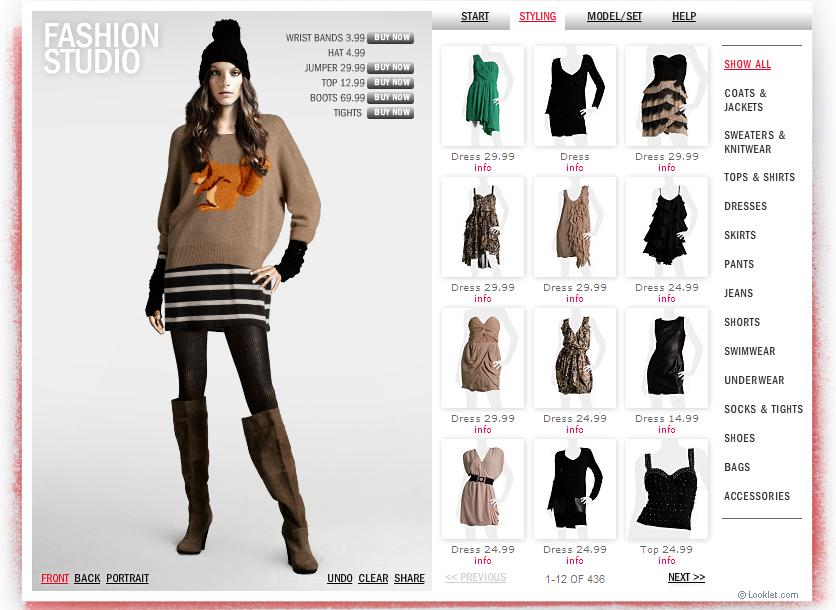
They use point-of-purchase promotion to get attention from consumers at the first sight. On one hand, they post a big photo about their new collections in the middle of front page, like a banner, informing consumers of their “best buy” clothes. On the other hand, they set up a brilliant interactive activity, called “fashion studio”. In that section, customers can try clothes on different kinds of models to see if the chosen clothes suit themselves. It makes the online shopping more vivid, just as being in a physical store. 

There is also a fantastic section, style guide, which is an online pictorial that tells customers what the current fashion trend is and shows how to be “in” style. When customers get a general idea about the popular style, they will recognize their needs and begin to shop online. So it evokes consumers’ need recognition imperceptibly.

Moreover, H&M applies video, magazine, facebook and cross-promotion with GQ magazine to provide more information about their brand and collections for customers. The purpose of it is to tell consumers that H&M has got variety of styles so that buyers can absolutely find the piece fits them perfectly.

Besides these fabulous promotion methods, H&M online shop has a problem with its delivery policy. Shoppers can not find any information about their delivery fee until they finish the payment part. People can only see the delivery fee after typing in all bank details and code. It is really an obstacle lying between buyer’s purchase intention and final purchase decision-making.

But all in all, the promotion methods of H&M are wonderful and impressive. We can dig out a lot of valuable concepts from study.